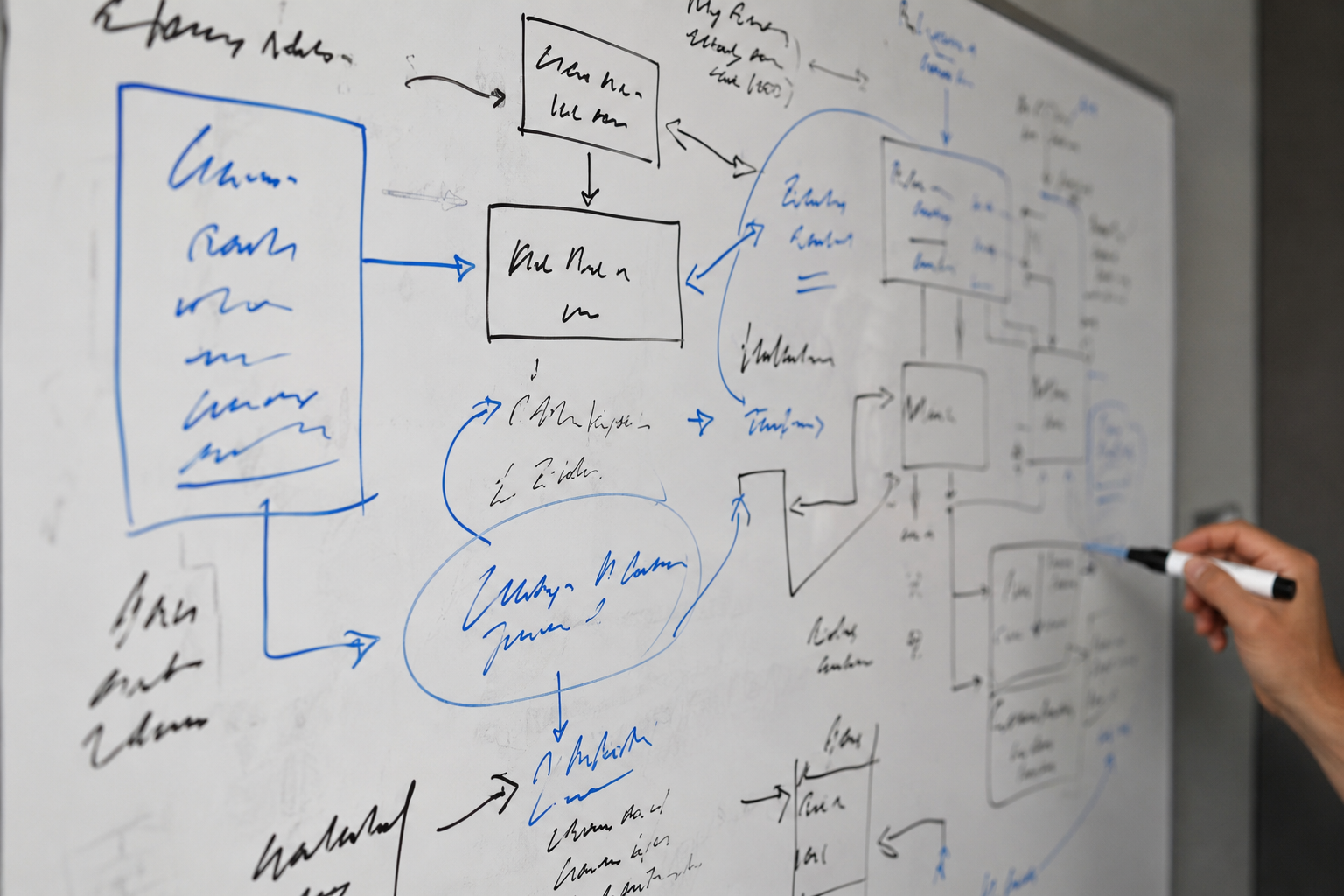
The phrase “AI-first prospecting workflow” gets thrown around enough to lose its shape. So let’s take it apart and look at what’s actually under the hood when a serious team runs one.
What follows is the workflow we operate at Generative Leads for our clients, broken into the seven stages that matter. It is not the only way to build this — there are real variations in tooling and architecture — but the underlying logic is consistent across every effective implementation we’ve seen.
Stage 1: Account Discovery
Goal: Build a list of accounts that genuinely fit the ICP, not a list of accounts that match a few firmographic filters.
The starting point is rarely a clean ICP definition. Most clients arrive with something like “B2B SaaS, 100–1000 employees, in APAC.” That’s a filter, not an ICP. A real ICP is operational: it describes how the buyer actually behaves, what triggers their interest, and what makes them different from the lookalikes that drain pipeline.
The discovery layer combines three sources:
Firmographic filtering through tools like Ocean.io, ZoomInfo, or Apollo to surface the universe of candidate accounts.
Lookalike modeling seeded from the client’s actual closed-won and lost-disqualified data. This eliminates the accounts that look like fits on paper but consistently fail in the funnel.
Manual enrichment for the markets and segments where database coverage is poor — typically Japan, Korea, and parts of Southeast Asia for APAC engagements.
The output is not a static list. It’s a living account universe that gets refined every two to three weeks based on conversion patterns we observe in earlier stages.
Stage 2: Signal Layering
Goal: Identify which accounts in the universe are most likely to be in-market right now.
A static account list is a 2018 motion. The 2026 motion overlays time-sensitive signals to prioritize the accounts most likely to convert in the next 60–90 days.
The signals we layer routinely include:
Hiring data — companies hiring roles related to the buyer’s function are often expanding capacity in that function and more open to new vendors.
Funding events — recent capital raises correlate with budget unlocking and tooling decisions.
Tech stack changes — adoption of a complementary tool, deprecation of a competitor, or signals of stack consolidation.
Leadership changes — new CTOs, VPs of Sales, or Heads of Operations are vendor-receptive in their first 100 days at meaningfully higher rates.
News and product mentions — companies talking publicly about the problem your product solves are warmer than companies that aren’t.
Website visitor identification — accounts already showing up on the client’s website have signaled intent we should not waste.
These signals are pulled through a combination of LinkedIn Sales Navigator, news APIs, hiring data feeds, and intent platforms, then aggregated through Clay or a custom orchestration layer into a single composite score per account.
The output: a prioritized list, refreshed weekly, where the top accounts are the ones with multiple converging signals.
Stage 3: Persona Mapping and Contact Discovery
Goal: For each prioritized account, identify the right humans to reach out to.
For most B2B SaaS deals, this is between three and seven people inside the account, spanning at least two seniority levels. The decision-maker (often a VP or Director), the economic buyer (often a layer above), the user (often a layer below), and any technical evaluators or finance gatekeepers.
The contact discovery layer combines:
Database lookups through ZoomInfo, Apollo, Lusha, and similar providers, with waterfall logic so we try the cheapest source first and escalate only when needed.
LinkedIn Sales Navigator searches to fill gaps, especially for non-US markets where database coverage is thinner.
Email validation through ZeroBounce or NeverBounce on every address before any outreach fires.
The output is not a flat list of contacts. It’s a structured persona map per account — who plays what role, who reports to whom, and who we’d lead with versus who we’d loop in later.
Stage 4: Research and Personalization Inputs
Goal: For each priority contact, gather the context that makes outreach feel deliberate rather than templated.
This is the stage where AI’s leverage shows up most clearly. For each contact, we run an AI research pass that pulls together:
Their recent LinkedIn activity (posts, shares, comments).
Their company’s recent news, hiring, and product announcements.
The team they appear to lead or sit within, based on org-mapping signals.
Any public statements they’ve made about the problem space we’re targeting.
The output is a 100–200 word “context brief” per contact that a human could reference when drafting outreach. This task used to take an SDR 15–25 minutes per contact. AI does it in seconds, with quality that’s genuinely useful as input to the next stage.
Stage 5: Messaging and Sequence Design
Goal: Produce outbound messaging that is specific, concise, and worth a reply.
This is the stage where we lean back on humans. AI produces first drafts; senior salespeople with category experience edit them. The reason is not philosophical — it’s empirical. Messaging quality is the single largest controllable variable in outbound performance, and the difference between an AI-generated draft and an edited final is often the difference between a 4% and a 12% reply rate.
The sequence design itself follows a few non-negotiables:
Multi-channel by default. Email and LinkedIn touches in coordinated sequence, with optional WhatsApp or SMS layered in for markets where it’s appropriate (more on the regional nuance in another article).
Asymmetric cadence. Touches are denser early, then space out. The fifth email two weeks later does not work. The fifth email at the right cadence and angle does.
Variant testing built in. Every sequence has at least two opener variants running in parallel from day one. We don’t guess what works; we measure.
Stage 6: Reply Handling and Qualification
Goal: Convert replies into meetings, and meetings into qualified opportunities.
The reply layer is where most automated workflows quietly fail. AI is good at categorizing replies. AI is much less good at the nuanced response that turns a soft “tell me more” into a calendared meeting.
We route every reply through a senior human within minutes. The categories are:
Hot — interested, ready to engage. Move to meeting booking immediately, with a tailored response.
Warm — curious but not committed. Engage with a follow-up that adds value without pushing too hard.
Cold — clear “no” or unsubscribe. Process cleanly and remove from sequence.
Out of person — they’re not the right contact. Re-route within the account.
The “hot” responses are where most of the commercial value lives, and they require a senior human to handle. We don’t automate them.
Stage 7: Measurement and Iteration
Goal: Improve the workflow every week based on observed outcomes.
We track outcomes at every stage:
Account-level: contact rates, reply rates, meeting rates per segment.
Persona-level: which personas reply, which don’t, in which segments.
Messaging-level: which variants outperform, by reply rate and meeting rate.
Channel-level: which channels move accounts forward, in which markets.
Every Friday, the team reviews the numbers, identifies the largest delta from the previous week, and ships a workflow change for the next week. Sometimes that’s a messaging variant retirement. Sometimes it’s an ICP segment reweighting. Sometimes it’s a new signal added to the prioritization layer.
The motion is not static. It cannot be. The teams that win at outbound treat their workflow the way good engineering teams treat production systems — observable, instrumented, and continuously improved.
The Architecture in Plain Terms
Stripped of the tool names, the workflow looks like this:
Find the right accounts.
Figure out which are in-market.
Identify the right people inside them.
Research each one well.
Write outreach worth replying to.
Handle replies like a human, not a bot.
Measure everything and improve weekly.
The AI does the parts that scale. Humans do the parts that judge. The workflow is the thing that connects them.
This is not magic, and it is not new. It is the disciplined application of available tools to the unchanged underlying problem of B2B prospecting. Most teams don’t have it because building it is harder than buying a sequencer license — but the gap between teams that have it and teams that don’t is wider every quarter.
At Generative Leads, this is the workflow we operate as a managed service for our clients — with the option to hand it over to internal teams when they’re ready to bring the capability in-house. If you’re trying to decide whether to build it, buy it, or partner on it, we’d be glad to walk you through ours in detail.